Thursday, February 12, 2009

Michael Phelps, Marijuana, and Corporate Hypocrisy


Ever since the now infamous photo of Michael Phelps with his lips sealed over a bong was published by London’s News of the World, the media’s demonizing coverage of Phelps has been disgraceful. Based largely on the public outcry crafted by America’s supposedly liberal media, Phelps has had his image and income permanently damaged by the seemingly harmless incident. Kellogg’s has stripped Phelps of his sponsorship. USA Swimming suspended him from competition for three months. These responses to the photo do nothing but further illustrate the ignorance, over-reaction, and hypocrisy that have plagued America’s view on marijuana for far too long.

Immediately after the media’s unnecessary eruption in response to the photo, Phelps held a press conference announcing his behavior was “regrettable” and “demonstrated bad judgment”. But how regrettable is an action that puts you in the company of over 100 million Americans, including the President of the United States? How bad is your judgment when you choose to use a recreational drug that is impossible to overdose on and is less addictive than cigarettes or alcohol? Michael Phelps was given an opportunity to use his respectable image and athletic accomplishments to spark public debate on these issues; instead he felt obligated to perpetuate the negative connotation that has unfairly developed around marijuana use in America.

As Bruce Mirken, Marijuana Policy Project spokesperson, recently told CNN, “I think it is sad that this incredibly accomplished young man feels like he is in a position of having to apologize and act like he did something terrible for relaxing with something that is safer than beer.”

In 2004, at the age of 19, Phelps was arrested in Maryland for DUI. This was a truly regrettable mistake in which Phelps endangered not only himself but others as well. The media response to the arrest was equally critical of the swimmer’s inexcusable behavior, but Phelps lost no sponsorships as a result of his actions. In fact, when it was apparent Phelps was going to have yet another dominating performance in the 2008 Beijing Olympics, many high-profile corporations ignored Phelps’ arrest record and offered him millions in new endorsement deals. The argument is not that Phelps did not deserve a second chance, the point is there is an obvious double-standard now developing as the media and sponsors condemn his marijuana use with more passion and vigor than they did following a much more serious incident of criminal behavior.

It is time that America has an open and honest public discussion on marijuana policy, for it is an issue that is only increasing on the political radar. Since 1996, 13 states have legalized medicinal marijuana use while others have decriminalized the drug despite its illegality under federal law. In fact, according to a 2005 Gallup poll, 36% of Americans believe marijuana should be legalized completely—a three-fold increase since 1969. Whether these progressive policies and changing opinions are the best options for America is debatable, but the fact that they can no longer be ignored is not.

While Michael Phelps apologizes for celebrating eight Olympic gold medals with a hit of pot; while the media shamefully avoids a thorough dissection of marijuana in America; while the US government arrests hundreds of thousands of its citizens every year for an act its leader has openly admitted he enjoyed--Let the rest of us be objective, honest, and rational in our thinking.

Monday, October 27, 2008

Palin Pulls the Plug on a McCain Presidency


After an election season that has dragged on longer than an Oliver Stone film, a couple realizations have finally emerged. 1) John McCain is not going to be the next president of the United States and 2) Sarah Palin is the culprit of his downfall.

Running a campaign that has sadly fallen further and further into desperation and fear tactics, John McCain has abandoned his once free-thinking, maverick, respected reputation in pursuit of a persona more akin to the same Republican base that he once alienated himself from. With an incumbent Republican president and the lowest approval ratings of all time, such a campaign decision was bound for failure. The subsequent decision to pick Sarah Palin as his running mate was a desperate attempt to get the best of both worlds—affirm the support of the party base while optimistically appealing to feminists, independents, and big-game-hunters of all ages—but the predictied results are devastating.

I try to keep a critical, yet fair view of politicians, and in Palin’s case, it is critical and fair to say she is not qualified to be the President of the United States. Talk all you want about executive experience, but when it comes down to it, Sarah Palin is scary. You can bash Katie Couric’s “truth-seeking” tactics all you want, but, when the McCain campaign finally stopped hiding the hockey mom, even Joe the Plumber must've doubted her. It wasn’t her lack of knowledge that made me wonder what the hell John McCain was thinking, it was her inability to hide it. Palin has come across in every unscripted public appearance unprepared to a point where you actually feel sorry for her, until you remember she has somehow managed to run for the second highest office in our country. Americans have already sacrificed intelligence for who they would rather have a beer with ,twice, and have finally (pray God) learned their lesson.

Perhaps the most embarrassing and insulting characteristic of Palin is her “folksiness”. To have an accent is one thing, but to butcher the English language in hopes of appealing to those who think it is genuine to butcher the English language frankly pisses me off. Palin lectures at her rallies as though she is introducing herself to a kindergarten class. “Now folks, there’s a couple things I wanna tell ya that I sure won’t be doin’. I won’t be pallin’ around with no terrorists and I won’t be talkin’ to no evil dictators’.” John McCain’s advantage in the Republican primaries was his ability to stand-out as an intelligent, non-patronizing voice in a field full of condescending bastards. This advantage has been crushed by Sarah Palin’s elementary tactics.

Both campaigns are guilty of going negative. In fact, both campaigns have run some of the most blatantly misleading ads of all-time. The difference between the two is their dependence on these tactics. Over 2/3 of Americans don’t want to see or hear about negative campaigning, and Obama seems to be the only one who has finally gotten the message (though not before destroying a large chunk of his ethics). When the financial crisis put the economy on the minds of every American, Obama was describing his plans for the future. Palin was talking about what William Ayers did when Barack Obama was 8 years-old. While Biden was discussing his involvement in the Congressional rescue plan, Palin was busy alienating half of American for the GOP ticket by calling small town America the “pro-America areas” of the country. The triviality of her most passionate talking points has placed her shallowness on the forefront of American minds, instead of John McCain’s experience. A distraction that is going to cost John McCain the election.

In trying to score a home run, John McCain has struck-out. Beauty can get you far in life--as Palin has proven—but its going to take more than Tiny Fey-looks and a $150,000 wardrobe to convince the American people you are ready to lead what still remains the most influential nation in the world. When it is all said and done, I think John McCain will realize (if he hasn’t already) the truth in the statement, “play to your strengths”. Experience. Authenticity. Compromise. These are the traits that could have won McCain the election…and Sarah Palin’s incompetency in all these areas is what will lose it.

Tuesday, September 2, 2008

The Pickens Plan (for Profit)

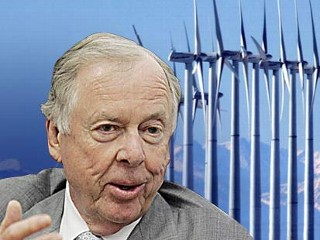
If you have watched any American television in the past month there is a good chance you have witnessed a commercial or two featuring a smiling old oil man talking over a backdrop draped in eco-friendly windmills; I give you T. Boone Pickens and his creatively-titled solution to the energy crisis in America, The Pickens Plan. With his authentic southern draw and down-home charm, T. Boone Pickens reminds one more of our current president (he donated millions to both Bush and the Swift-boat attacks on John Kerry) than he does of an alternative-energy advocate trying to cross partisan-lines and solve perhaps America’s most prominent problem. This impression may unfortunately hold a bit more legitimacy than one may hope, especially after conducting a bit of research into the life and motives of Pickens himself.

The Pickens Plan is a mass public relations campaign financed by who other than Mr. Picken’s himself, an effort he has put $58 million of his personal fortune into (Pickens earned $2.7 billion in 2007 alone). With a website that could have been designed by Al Gore himself and ads filled with liberal talking-points, it is an obvious attempt to blur the line between parties and make a desperate appeal for nationwide consent. In his plan, Pickens outlines what exactly has caused the energy crisis in America, and what exactly he plans to do about it.

In 1970, America imported 24% of its oil; In 2008, America imports 70% of its oil. This dependence on foreign oil is annually costing America upwards of $700 billion, while doing nothing to improve its struggling economy. Furthermore, America uses approximately 25% of the world’s oil, while constituting less than 5% of its population. Based on these eye-opening statistics, it is obvious that something transformative and drastic must occur. Who better to tell us than one of the richest oil men in the world.

Picken’s plan focuses on two changes in American energy infrastructure. Firstly, he proposes a dramatic increase in the use of wind energy for electricity production, claiming, with the help of colorful graphs, that America is the Saudi Arabia of wind power. Optimistically, Pickens claims that a mass investment in wind power would create enough energy to satisfy 20% of America’s energy needs. With this new-found electricity in production, the second key component of Pickens Plan is to use our natural gas reserves for transportation purposes (it is a clean burning, cheap fuel) rather than additional electricity. This will obviously get America off gas and spark a new wave of natural gas vehicles and fuel stations. If all goes according to plans (The Pickens Plan that is), America would save $300 billion annually.

The plan has potential. Both John McCain and Barack Obama have met with Mr. Pickens in the past couple months and rumors of a Secretary of Energy reserved for T Boone have been circulating now for some time, but I’m not convinced. If the Bush years have taught me anything about Washington, it is to not trust those who hold personal ties with big business and have a personal financial stake in the policies of the government. I have learned that despite populist rhetoric and what appear to be genuine intentions, businessmen in the political realm never seem to get away from that not-so-invisible hand of self-interest. T. Boone Pickens and his nation-saving plan is no different.

A closer look at Pickens himself reveals the true motivation behind his now famous plan. In regards to wind energy, Pickens owns Mesa Power. Mesa Power is the largest wind energy company in the world and has already built the most expensive wind farm in the US, with existing plans to purchase a substantial amount of wind turbines. Could this be the reason Pickens Plan fails to focus on other established alternative energy sources, say solar? Pickens also owns a company that conveniently changed its name in 2004 from ENRG to Clean Energy, specializing in natural gas fueling stations. Coincidence? Perhaps that’s the reason hybrid cars aren’t even mentioned in Pickens Plan.

While it is obvious that America is suffering from an energy crisis, it is important for Americans to maintain a critical eye and not merely accept whatever potential solution they are presented with. It is equally important to take a closer look at who is presenting the potential solution, and the possible ulterior motives such a person may possess. It is not obvious to me that T. Boone Pickens’ plan for personal profit is necessarily a bad decision for America. It is obvious to me that it is a decision organized around a personal agenda. Such an argument must always be looked at skeptically when attempting to pursue what is best for the public and nation as a whole.

Wednesday, August 27, 2008

Wilco wows Wilmington

Last review of the summer, posting it here so I can add media, but as always, the real version is over here.

***All photos courtesy of Paste Music Blog***

Wilco
Wilmington, DE

Au
g. 10, 2008

“We’ve now played 48 out of 50 states,” Jeff Tweedy proudly announced to the sold-out crowd at Wilmington’s Grand Opera House. “We’ll hit 49 next week,” he continued, alluding to Wilco’s headlining slot at the Jackson Hole Festival in Wyoming. Earlier this year, Tweedy and Co. announced plans to perform in cities and states otherwise ignored over the course of Wilco’s 14-year career. In addition to wowing newer fans at mega-fests such as Lollapalooza or Baltimore’s Virgin Mobile Festival, Wilco’s summer tour took it to the geographic edges of its U.S. fanbase, with dates in Montana, New Mexico, Alaska and North Dakota. The band’s performance in the historic Delaware auditorium spanned their celebrated nine-album catalog (save a curious absence of anything from 1999’s Summerteeth).

A Dylan-channeling version of “Sunken Treasure” kicked off the night while Tweedy’s blows on a neck-strap harmonica drew wild hoots and whistles from the mostly older audience. The gradual pace continued through the noise-infused interludes of “Wishful Thinking” and “I Am Trying To Break Your Heart,” until Glen Kotche’s unyielding cymbal attack and full-body flailing outshone the iconic lead singer. Kotche’s drumming remained tight throughout the evening, as did the work of bassist John Stirratt, the band’s only original member besides Tweedy. The Wilco line-up has shuffled through 12 members since its 1994 inception following the break-up of Tweedy's alt-country trailblazers Uncle Tupelo. The recent addition of multi-instrumentalist Pat Sansone and acclaimed jazz guitarist Nels Cline continues to flesh out the band’s earlier work into lush, layered compositions, particularly in a live setting.

Additional support for this performance came by way of the Total Pros, a three-piece horn section that sat in for six songs, including “I’m The Man Who Loves You”, “The Late Greats” and "Outtasite (Outta Mind)." The extra instrumentation, while fluid and precise, often led to an oversaturated sound and confirmed what many critics have argued since the lukewarm reception of 2007’s Sky Blue Sky: late-period Wilco is upon us. Many moments of the band’s 24-song set felt politely jammy, and Tweedy stumbled through select rarities such as “Casino Queen,” “Blood Of The Lamb” (a Woody Guthrie cover from the band’s collaboration with Billy Bragg), and “Hotel Arizona,” which needed three re-starts before getting off the ground.

Wilco - "Hotel Arizona" - Live @ The Grand Opera House, Wilmington, DE - 8/10/08

Aside from these slips, the neo-jazz breakdown of “You Are My Face” and vapor-trail ending of “Handshake Drugs” both allowed Cline to stretch his wings. Cline’s handiwork routinely transcended his Fender Jazzmaster to include intricate toggling on a side table of effects and soulful slide-guitar fingering to dress up such songs as “Poor Places” and “Walken,” the latter an otherwise forgettable cut from Sky Blue Sky.

Wilco - "Poor Places" - Live @ The Grand Opera House, Wilmington, DE - 8/10/08


It was clear that an unspoken dialogue was at the heart of Wilco’s first interaction with their First State fans. The bouncy, transcendental anthem “Hummingbird” was a full-fledged sing-along, and “Theologians” felt especially drenched in enigmatic mysticism when cryptic lyrics echoed from fans around the horseshoe theatre. “You can rely on me, honey,” Tweedy assured the swaying crowd during the twangy Southwestern waltz of “Jesus, Etc.” Turning his microphone toward the audience, they echoed back, “Our love is all we have. Our love is all of God’s money. Everyone is a burning sun.”

Wilco - "Radio Cure" - Live @ The Grand Opera House, Wilmington, DE - 8/10/08

Thursday, August 21, 2008

A Thunderous Blunder: A Review of Tropic Thunder

Ben Stiller’s new flick, Tropic Thunder, has topped the box office, sparked considerable controversy, and features Robert Downey Jr. playing Russell Crowe playing Bernie Mac; enough to convince me it was worth checking out. It has been awhile since I’ve encountered such a contradictory film--horrid reviews yet an 8.0 on IMDb?—making me wonder which constituency was so off the mark. After viewing the film I was surprised to find that the answer was neither, and concluded that Stiller had succeeded in creating a horribly hilarious film.

What the film makes up for with a top-notch cast and memorable one-liners, it completely lacks in plot, respectability, and timely satire. What could have been an opportunity to make a masterful satire of an entire genre (a la Mel Brooks), the movie instead relies on crude humor and very memorable characters to make its comedic impact. With a few exceptions, Tropic Thunder fails to give the audience the chance to think, “this is a spoof”, or “they are making fun of _________ war movie”. Clichés aren’t absent from the film but their prevalence would have allowed Tropic Thunder to be put in the same class of satire as say Blazing Saddles or Team America, instead opting out to be placed in the shadow of Apatow-inspired blatantly belligerent comedy.

As previously stated in my last post, I am no moralist. I often take an unhealthy loathing to those too uptight to take a joke and attempt to place what is meant to be humorous in the comedic context that is appropriate. With that said, I must honestly say even I found parts of the film tasteless and mildly offensive. It is one thing to address the somewhat comedic fact that actors who choose to play mentally-challenged characters win Oscars, it is another to make Stiller’s retarded character an otherwise pointless centerpiece in the film. Downey Jr.’s rant about the professional downside of “going retard” had its place in a film making a consistent social commentary on the culture of Hollywood, but the repetitive stuttering and unnecessary return to Simple Jack did not have a relevant place in the film (unless it was Stiller’s goal to piss off advocacy groups of the subject).

While I found the retard controversy quasi-legitimate, those who opposed Robert Downey Jr. playing a black man need to shut the hell up. His performance as Kirk Lazarus was brilliant, and made fun of Russell Crowe as much as it did any black man. Not only was his character believable, his multiple accents spot on, and his reactions hilarious, but his ability to change his tone and personality with the wide array of other characters he had to deal with was remarkable. In a film that was otherwise full of forced jokes and largely missed the mark, Downey Jr.’s performance was both memorable and Oscar-worthy.

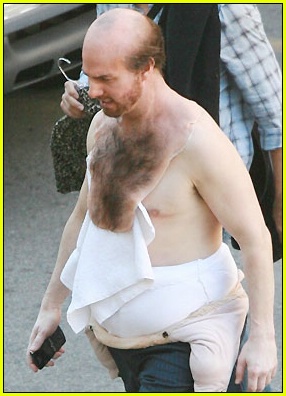
While Downey stole the show, the extensive and celebrity-filled cast is what ultimately made Tropic Thunder tolerable and perhaps even enjoyable. Every character was extremely well developed, from a fraud author attempting to profit off the Vietnam War to a rookie director trying to control a star-studded cast in his first big break. The parts were distinct and all allowed to for comedic touches to be added by the all-star cast. In a film riddled with cameos, Tom Cruise’s performance was the cameo to end all cameos. His heart-warming portrayal of a cross between Harvey Weinstein and Freakshow from Harold and Kumar with a fetish for rap and narcissism had me rolling in laughter. Unfortunately his screen-time was very limited.

All in all, Tropic Thunder wasn’t entirely a Tropic Blunder, but it sure as hell wasn’t a Tropic Wonder either. The movie has enough memorable moments and surely enough memorable characters to be worthy of a viewing, but falls a few RPG’s short of being a successful military satire. 6/10 Retards.